Tired of losing your family’s favorite recipes? This simple tech fix saved ours
Family recipes are more than just instructions—they’re love, history, and connection passed through generations. But how many of us have frantically searched through dusty notebooks, faded index cards, or text messages just to find Grandma’s famous pie? I lost count—until a small digital shift changed everything. What felt like a constant race against memory became a joyful ritual of sharing, preserving, and cooking together, no matter the distance. This isn’t about fancy apps or complicated tools—it’s about protecting what matters most, one recipe at a time.
The Recipe That Almost Got Lost
It was my grandmother’s cinnamon apple cake—the one she baked every Thanksgiving without fail, the kind that filled the house with warmth before you even opened the oven. I remember standing beside her as a child, watching her crack eggs with one hand, sprinkle cinnamon like magic dust, and hum old hymns under her breath. That cake wasn’t just dessert. It was comfort. It was home. Years later, after she passed, I took on the responsibility of keeping her tradition alive. I had her recipe written in her looping cursive on a yellowed index card, tucked inside my kitchen drawer.
Then came last year’s holiday season. I reached for the card, ready to bake for my own family, only to find a sticky smear of something unidentifiable—and half the instructions gone. Someone had used it as a coaster, then tried to wipe it clean. My heart sank. I could remember some of it—the two sticks of butter, the tart Granny Smiths—but the exact amount of cinnamon? The secret pinch of nutmeg she always whispered about? Gone. I tried calling my aunt, but she only remembered bits. We both ended up guessing. The cake was edible, sure, but it wasn’t hers. It lacked soul.
That moment hit me harder than I expected. It wasn’t just about dessert. It was about losing a piece of who we were. And I realized: how many other families have stood where I stood? How many irreplaceable recipes vanish quietly—not stolen, not burned, but erased by time, spills, or simple forgetfulness? That’s when I decided enough was enough. I wasn’t going to let another family memory disappear because it lived on a scrap of paper.
Why Paper and Memory Aren’t Enough Anymore
We’ve all done it—written a recipe on whatever was nearby: the back of an envelope, a grocery receipt, a sticky note stuck to the fridge. And for years, that worked. But life moves fast. Kids grow up and move across the country. Parents age, and their memories fade. Kitchens get remodeled, drawers get cleaned out, and with them, pieces of our past quietly vanish. I once found my mom’s handwritten lasagna recipe in a shoebox in the garage, buried under old tax files. How many other treasures are hiding in places we’ll never think to look?
And even when the paper survives, it’s not always accessible. Imagine your daughter living in Seattle, wanting to make your chicken pot pie for the first time. She calls you on a Sunday afternoon, pan in hand, asking, “How much thyme do you use?” You’re on speakerphone, flipping through a cookbook that’s falling apart at the seams. Or worse—you can’t find it. You promise to send a photo later, but life gets busy, and by the time you do, she’s already made a version with guesswork.
Then there’s the issue of memory. We assume we’ll remember how Mom made her cornbread or how Aunt Linda always knew when the bread was done just by tapping the bottom. But those subtle cues—how the batter looked, how long she let the dough rise, the sound the pan made when it was hot enough—those aren’t written down. They live in stories, in gestures, in moments we don’t realize are precious until they’re gone. Relying on paper and memory alone is like building a house on sand. It might stand for a while, but one storm, one spill, one misplacement, and it’s gone.
Worse still, keeping recipes in isolation keeps families apart. When each person holds just a fragment—your brother remembers the stuffing, your cousin has the cookie recipe, you’ve got the gravy—that collective knowledge stays scattered. We miss the chance to share, to learn, to feel connected through something as simple as a meal. The truth is, in our fast-moving world, tradition needs a little help to survive. And that help doesn’t have to be complicated.
The Turning Point: From Chaos to Clarity
I didn’t set out to become a tech expert. I’m not the kind of person who downloads apps for fun or spends hours setting up smart home devices. But after the cake disaster, I started looking for a better way. I didn’t want something flashy or hard to use. I just wanted something that worked—something my 78-year-old mom could use as easily as my 14-year-old niece.
One night, while complaining to a friend over coffee, she mentioned she’d started using a simple app to store her family’s recipes. “You can add photos, notes, even voice recordings,” she said. “And everyone in the family can access it.” I’ll admit, I rolled my eyes at first. Another app? Really? But she showed me hers, and I was stunned. There was her grandmother’s peach cobbler, complete with a photo of the original handwritten card, a picture of the finished dish, and a 30-second voice note of her mom saying, “Don’t skimp on the butter, sweetheart. That’s what makes it sing.”
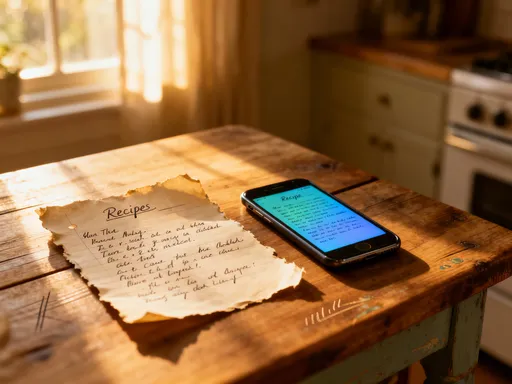
That was the moment it clicked. This wasn’t about technology for technology’s sake. This was about love. This was about making sure the next generation didn’t have to guess. So I took a deep breath and downloaded the same app. Setting it up took less than ten minutes. I created a shared family space, invited my mom, my sister, and my aunt, and uploaded my first recipe: my grandmother’s apple cake. I snapped a photo of the stained index card, typed out what I remembered, and added a note: “This is how Grandma made it. Let’s get it right for next time.”
Within hours, my mom replied with a voice message: “You forgot the vanilla! One full teaspoon, always.” My aunt chimed in with, “And she used a glass pie dish—said metal changed the taste.” Suddenly, the recipe wasn’t just text. It was alive. It was conversation. It was connection. And just like that, the panic I’d felt about losing it began to fade. For the first time, I felt like I wasn’t just preserving a recipe—I was keeping a legacy.
How One Digital Space Brought Us Closer
What started as a practical fix became something much deeper. Our family recipe hub turned into a living scrapbook, a place where food and memory intertwined in the most beautiful way. My mom began recording short videos of herself making her famous meatloaf, narrating as she went: “See how I press the ketchup into the top? That’s my mother’s trick.” My teenage nephew, who I never thought cared about cooking, uploaded his version of my sister’s mac and cheese, complete with a photo of his dog waiting hopefully under the table.
But the most touching moment came when my 82-year-old father, who rarely uses his phone for anything beyond calls, recorded a voice note about his mother’s dumpling soup. “She never measured,” he said, his voice softening. “She’d say, ‘You know it’s right when it smells like love.’” He paused, then added, “I miss that smell.” I cried when I heard it. Because this wasn’t just about soup. It was about him sharing a piece of his childhood, his grief, his love—all through a recipe.
What surprised me most was how this simple act of digitizing recipes brought us together, even when we were miles apart. When my sister had a rough week, she texted me: “Made Mom’s chicken soup tonight. Felt like she was here.” When my cousin had her first baby, she made my grandmother’s oatmeal cookies and sent a photo: “Feeding my daughter the same things I ate as a kid.” These weren’t just meals. They were emotional lifelines.
And the best part? It became interactive. My niece started tagging recipes with emojis—🎂 for birthdays, ❤️ for “Mom’s best.” My brother began adding tips: “Try adding a splash of apple cider to the gravy—elevates it.” We weren’t just storing recipes. We were building a shared language, a digital hearth where everyone could gather, contribute, and feel seen. Cooking, once a solitary task, became a family activity—even when we weren’t in the same kitchen.
Making It Work for Real Life (Not Just Tech Nerds)
I know what you might be thinking: “This sounds nice, but I’m not great with technology. I barely know how to send a photo.” First, let me say: I was right there with you. I didn’t grow up with smartphones. I still misplace my glasses on top of my head. But this wasn’t hard. The app I used was designed for real people, not tech experts. It looked like a photo album, not a spreadsheet. Uploading a recipe took less time than writing it on paper.
Here’s how we made it work: We started small. I didn’t try to digitize fifty recipes in one night. I picked five—my grandmother’s cake, my mom’s meatloaf, my aunt’s cookies, my sister’s soup, and my own banana bread. I snapped photos of the handwritten cards, typed them into the app, and added a short note about why each mattered. Then I invited three family members to join. That’s it. No pressure. No perfection.
We organized the recipes in ways that made sense to us—not by course or ingredient, but by memory. We have a folder called “Thanksgiving, the Way Grandma Made It” and another called “Mom’s Weeknight Comforts.” We even created a section called “Kitchen Disasters (and How We Fixed Them)” after my brother burned the roast and figured out how to salvage it with a gravy boost. It’s not just practical—it’s honest. It shows that cooking isn’t about perfection. It’s about love, effort, and showing up.
Privacy was important to us, so we chose an app that allowed us to keep the recipe book private—only invited family members could see it. No ads, no data mining, no strangers commenting on Grandma’s pie. This was ours. And because it synced across devices, I could pull up the cornbread recipe on my phone while standing in the grocery store, or my mom could access the casserole instructions on her tablet while preheating the oven.
The key was simplicity. We didn’t need bells and whistles. We needed something that felt natural, like adding a new page to a well-loved cookbook. And once we got started, momentum built. My cousin added her father-in-law’s barbecue rub. My nephew uploaded his college ramen hack. It wasn’t about being fancy. It was about being together.
More Than Food: What We Actually Saved
When I first started this project, I thought I was saving recipes. But what I’ve really saved is something far more precious: identity. These dishes are threads in the fabric of who we are. They connect my daughter to a grandmother she never met. They remind my brother of Sunday dinners after church. They ground us when life feels chaotic.
I’ve come to see our digital recipe book as more than a collection of ingredients. It’s a living heirloom. Unlike a vase or a watch, it grows with us. New recipes are added. Old ones are revisited. Stories pile up like layers in a lasagna. And because it’s digital, it’s durable. It won’t fade, burn, or get lost in a move. It can be passed down with a simple share link, not a will.
But perhaps the most unexpected gift has been emotional safety. In times of grief, illness, or loneliness, cooking a family recipe feels like being hugged. When my mom was recovering from surgery, she asked me to make her mother’s chicken and dumplings. As I stirred the pot, reading her voice note about “letting the broth simmer until it tastes like patience,” I felt her presence. It wasn’t magic. It was memory, made tangible.
And for the younger generation, it’s a bridge. My daughter loves browsing the app, asking, “Did Great-Grandma really use lard in her pie crust?” “Why did Uncle Joe call this ‘Hangover Helper’?” These questions spark conversations we might never have had otherwise. History isn’t in a textbook. It’s in the way we season our potatoes, the way we fold our dumplings, the way we say, “This is how we’ve always done it.”
In a world that often feels disconnected, this small act of preservation has become an anchor. It reminds us that we come from somewhere. That we belong. That even when we’re apart, we’re still a family, gathered around the same table—just in different kitchens, using the same recipes, feeling the same love.
Start Today: Protect What Can’t Be Replaced
You don’t need to digitize your entire collection tomorrow. You don’t need to be a tech whiz. You don’t even need to do it all at once. Just start. Pick one recipe—the one that makes you smile, the one your kids beg for, the one that smells like home. Take a photo of it. Upload it to a simple, private app. Add a note: “This is Grandma’s. She made it every birthday.” Or record a 30-second voice memo: “This is how Mom taught me.”
Then invite one person to join you. Your sister. Your mom. Your daughter. Let them add their own voice, their own memory. You’ll be amazed at what unfolds. This isn’t about replacing tradition. It’s about protecting it. It’s about making sure that when your granddaughter wants to bake your famous chocolate cake, she doesn’t have to guess. She’ll hear your voice saying, “Don’t forget the espresso—it’s the secret.”
Technology gets a bad rap sometimes. We hear about screens pulling us apart, about social media stealing our attention. But used with intention, it can do the opposite. It can bring us closer. It can preserve what matters most. Your family’s recipes are not just instructions. They are love stories. They are history. They are home.
So take that first step. Snap that photo. Record that voice note. Share that recipe. Because the simplest tools—a phone, an app, a shared moment—can do something extraordinary: they can keep your family’s love alive, one dish at a time. And isn’t that worth a few minutes of your day?