More Than Just Screens: How Our Mornings Got Calmer and Closer
Imagine waking up not to chaos, but to soft light, gentle music, and your child’s voice asking what’s for breakfast—while you’re still half-asleep. That’s what changed when our family started using a shared digital space each morning. It didn’t replace our routines—it improved them. No more yelling, missed reminders, or rushing. Just simple, calm connections that made us feel more present, together, from the first moment of the day. If you’ve ever felt like your mornings are a race nobody signed up for, you’re not alone. And what if I told you that the very thing we often blame for distraction—technology—could actually help bring your family closer, right when the day begins?
The Morning Mayhem No One Talks About
Let’s be honest—most of us don’t wake up to a peaceful sunrise and quiet reflection. We wake up to alarms, unanswered texts, and the sudden panic of realizing someone forgot their gym clothes. Again. The morning rush isn’t just noisy; it’s emotionally draining. You love your family deeply, but by 7:15 a.m., you’ve already snapped at your partner for leaving the coffee pot empty and reminded your kid three times to brush their teeth. Sound familiar?
I used to dread waking up. Not because I didn’t want to see my kids, but because I knew what came next: a whirlwind of decisions, corrections, and last-minute scrambles. The kids would stumble out of their rooms, still half-dreaming, and I’d already be three steps ahead in my head—packing lunches, checking backpacks, trying to remember if the dog had been fed. And yet, despite all that mental effort, something always slipped through the cracks. Homework forgotten. Permission slips unsigned. Socks mismatched. The guilt would creep in: Am I failing them before the day even starts?
And here’s the thing—this kind of stress doesn’t just fade by midday. It lingers. It sets the tone. A chaotic morning makes you feel scattered, reactive, and emotionally worn before you’ve even left the house. You carry that tension into work, into conversations, into your relationships. What if we could change that? What if the solution wasn’t doing more, but doing less—more intentionally? That’s when I started wondering: Could technology, the same thing that often pulls us apart, actually help us come together?
Discovering Family Digital Spaces—Not Just Another App
At first, I thought the answer was another parenting app. You know the kind—colorful icons, push notifications, chore charts with digital stickers. I tried a few, but they didn’t stick. Why? Because they felt like extra work. Another thing to log into. Another screen to manage. What finally made a difference wasn’t an app at all. It was the idea of a family digital space—a shared, central hub where all the little pieces of our morning routine could live together.
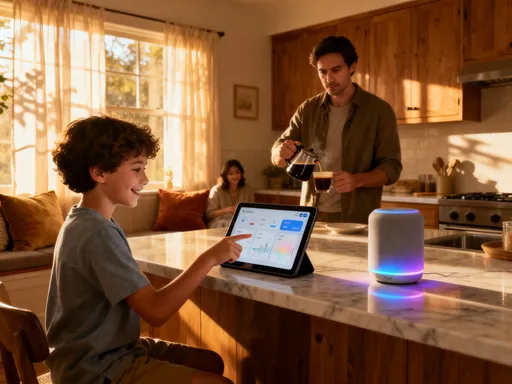
Think of it like a digital kitchen table. It’s not one single tool, but a connected system. Our calendar is there. So are our morning playlists, visual schedules, and even little messages we leave for each other. We access it through a smart display in the kitchen, our phones, and a tablet near the front door. The magic isn’t in any one device—it’s in how they work together to create rhythm, not more noise.
I remember the moment it clicked. One morning, my daughter walked into the kitchen, looked at the screen, and said, “Oh! Today’s ‘pack your own lunch’ day.” No reminder from me. No nagging. She just knew. And in that second, I realized something powerful: this wasn’t about controlling our family. It was about freeing us. Freeing our minds from the mental load of remembering everything. Freeing our voices from having to repeat the same instructions. And freeing our hearts to actually enjoy being together.
A family digital space isn’t about high-tech wizardry. It’s about creating a shared understanding. It’s visual. It’s predictable. It’s calm. And most importantly, it’s ours. We built it together, and it reflects how we live—not how some app thinks we should.
How Our Mornings Transformed—One Small Change at a Time
We didn’t overhaul everything overnight. That would’ve been overwhelming—for me, and for the kids. Instead, we started with one small thing: a shared morning playlist. We picked songs that felt warm and gentle—nothing too loud or jarring. The first song would play softly through the smart speaker in the living room at 7:00 a.m., just as the lights slowly brightened. It wasn’t a blaring alarm. It was an invitation to wake up.
That small change did something surprising. It gave the morning a rhythm. The kids began to associate that first song with stretching, yawning, and heading to the bathroom. No yelling. No urgency. Just a natural flow. And because the music played in multiple rooms, everyone heard it at the same time. We were starting the day on the same beat.
Next, we added a visual schedule on the smart display in the kitchen. Simple icons showed the morning steps: wake up, brush teeth, get dressed, eat breakfast, pack backpack. At first, I worried the kids wouldn’t pay attention. But they did. In fact, they started checking it themselves. “I already did ‘brush teeth’!” my son would say proudly, tapping the screen to mark it complete. The screen didn’t replace parenting—it just made it easier. I wasn’t the only one who knew what came next. The routine belonged to all of us.
Over time, we layered in more: a shared calendar that showed school events, my work meetings, and even the dog’s vet appointment. A digital sticky note where I could leave a quick message: “Don’t forget your library book!” Or “I love you. Have a great day.” These weren’t grand gestures. But together, they created a sense of being seen—like someone was paying attention, even when we were moving fast.
Making It Work for Real Families—Not Perfect Ones
Of course, it hasn’t always been smooth. There are still mornings when the Wi-Fi drops, or someone ignores the screen, or the playlist skips to a song that feels way too energetic for 7 a.m. (Looking at you, upbeat pop remix.) And that’s okay. The goal isn’t perfection. It’s progress. The real test of any system isn’t whether it works every single day—it’s whether it can bend without breaking.
One of the biggest lessons I’ve learned is to keep it flexible. For example, when my youngest was struggling to follow the visual schedule, we added color-coded icons. Green for “go,” yellow for “almost done,” and red for “stop and check with Mom.” We also started using voice cues: “Time to move to the next step,” the smart speaker would say gently. It wasn’t about control—it was about support.
Another key? Letting the kids help design it. We had a family meeting one weekend and asked: “What would make mornings easier for you?” My daughter suggested adding a “fun fact of the day” to the screen. Now, we start every morning with something silly or surprising: “Octopuses have three hearts!” It makes us laugh. It makes us pause. It makes us connect.
And yes, sometimes someone forgets. Sometimes the system fails. But instead of falling back into old patterns of frustration, we pause and ask: “What do we need to fix?” Maybe the reminder wasn’t clear. Maybe the timing was off. We adjust, we try again. The digital space isn’t a rulebook—it’s a living part of our family life, growing and changing with us.
Strengthening Connection, Not Just Efficiency
Here’s what I didn’t expect: the biggest benefit wasn’t saving time. It was saving space—emotional space. When we weren’t so busy managing every detail, we had room to actually be with each other. We started greeting each other at the door. Sharing little things: “I packed my favorite sandwich today!” or “I had the best dream last night.” These moments used to get lost in the rush. Now, they’re part of the rhythm.
The shared digital space didn’t just organize our tasks—it organized our attention. Instead of scanning the room for what needed fixing, I could look my kids in the eye and say, “Good morning. How did you sleep?” That small shift made a huge difference. I felt more like a parent, and less like a project manager.
We also added a shared photo feed. Each morning, one of us can post a picture—maybe last night’s dinner, or a drawing, or the dog in a funny pose. It’s not about perfection. It’s about presence. Seeing a photo of your child’s artwork first thing in the morning does something quiet but powerful: it reminds you what matters.
And here’s the truth: connection doesn’t always come from big moments. It comes from the small, consistent ones. The shared playlist. The morning message. The visual checkmark. These aren’t just tools—they’re tiny acts of care. They say, “I thought of you. I made space for you. You belong here.”
Setting It Up Without the Stress—A Simple Guide
If you’re thinking, “This sounds great, but I’m not tech-savvy,” I get it. I wasn’t either. The good news? You don’t need to be. This isn’t about buying the latest gadget or learning complex software. It’s about starting small and building something that works for your family.
Here’s how we did it—step by step. First, we picked one thing to focus on. For us, it was the morning playlist. We used a free music app we already had and created a “Family Mornings” playlist with songs that felt calm and uplifting. We connected it to a smart speaker in the kitchen and set it to play at the same time every day. That was our foundation.
Next, we added a visual schedule. We used a simple family app with drag-and-drop icons. No complicated setup. We sat together as a family and chose the images that made sense to us. A toothbrush. A bowl of cereal. A backpack. We placed the tablet on the counter where everyone could see it. The key was making it visible and shared.
Then, we linked our calendars. Most of us already used digital calendars, so we just made sure we were sharing them with each other. We color-coded events: blue for school, green for family time, red for appointments. Now, when I plan my day, I can see at a glance what everyone else has going on. It helps me anticipate busy mornings and plan accordingly.
Finally, we added ways to connect. A digital message board. A shared photo album. A “gratitude jar” where we could type one thing we’re thankful for each morning. These weren’t technical feats—they were emotional anchors.
The most important part? We did it together. We didn’t force it. We invited the kids to help, to suggest changes, to own it. And we gave ourselves grace when it didn’t work perfectly. You don’t need the most expensive tools. You don’t need to do it all at once. Start with one small step. See how it feels. Then build from there.
A New Kind of Morning—Calm, Connected, and Fully Ours
Now, when I wake up, I don’t feel that familiar knot of stress. I hear the soft music. I see the gentle light. I walk into the kitchen and find my daughter already checking the schedule, humming along to the playlist. My son waves from the table, mouth full of toast. “Morning, Mom!”
These moments aren’t perfect. But they’re present. And that’s what I wanted all along. Technology didn’t take over our mornings—it protected them. It didn’t replace our connection; it made space for it to grow. We’re not a perfectly organized family. We’re a real one. And that’s enough.
What I’ve learned is that the best technology doesn’t shout for attention. It whispers. It supports. It helps us show up as the people we want to be—calmer, kinder, more connected. If your mornings feel like a race, I want you to know: it doesn’t have to be this way. You don’t have to do more. You don’t have to be harder on yourself. You just need one small change to begin.
Imagine a morning where you’re not counting down the minutes until everyone’s out the door. Imagine one where you actually look at your family and smile. Where you say, “I’m glad we’re doing this together.” That’s the kind of morning we’ve built—not with magic, but with intention. And if we can do it, so can you. Start small. Be kind to yourself. And remember: the most powerful technology in your home isn’t in the devices. It’s in the love you share. Let it lead the way.